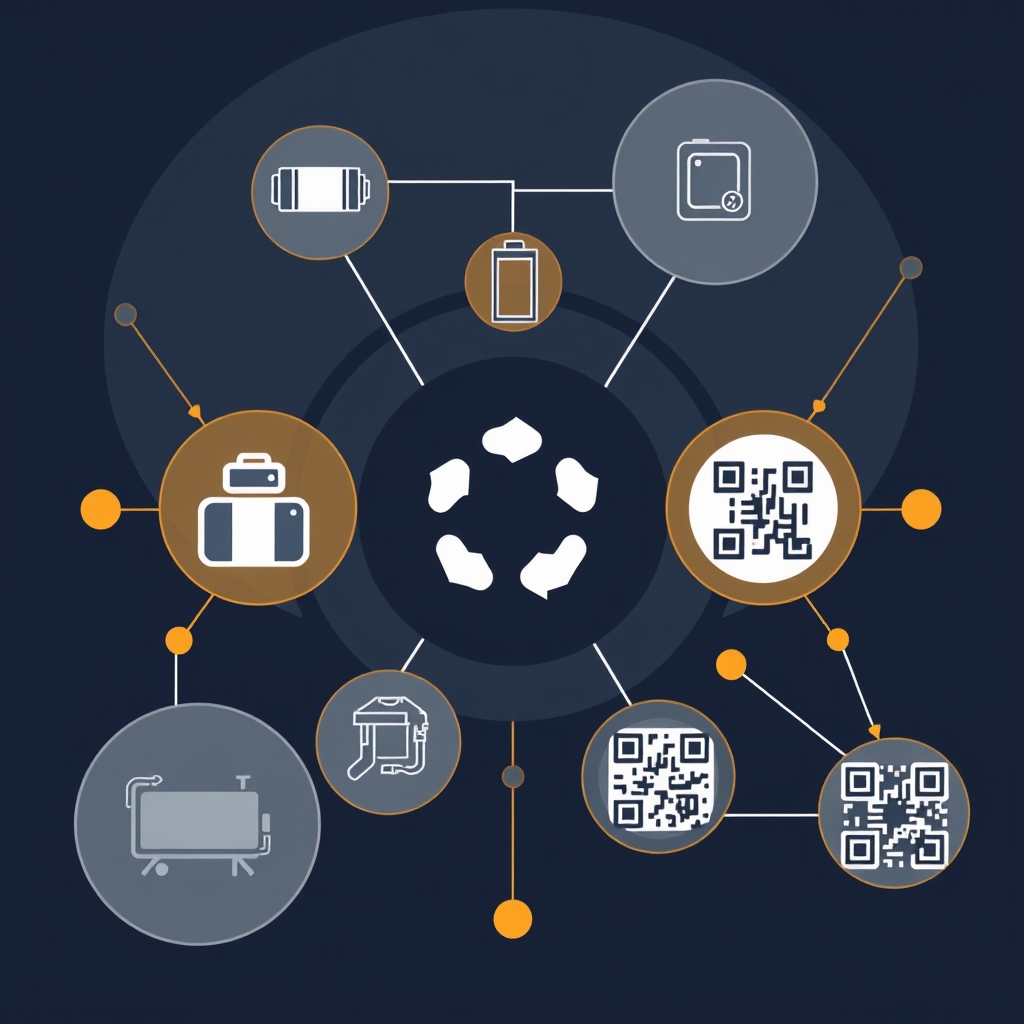
A Pivotal Month: Why May 2026 Matters for the DPP
Rarely do regulatory turning points cluster as densely as they have in May 2026. Within just a few weeks, the European Commission published the draft Implementing Regulation for the DPP Registry, launched a pilot for battery passports, clarified exemptions to the destruction ban on unsold textiles — and the GS1 General Assembly in Warsaw is simultaneously debating the final roadmap for the transition to 2D barcodes. Read the signals correctly and one thing becomes clear: the clock is moving faster than many compliance teams have planned for.
The legal foundation for all of this remains the ESPR Regulation (EU) 2024/1781, which has been in force since July 2024. It establishes the framework for the Digital Product Passport (DPP) while leaving product-specific requirements to downstream implementing acts — and those acts are now taking shape.
The DPP Registry: What the Commission's April 29 Draft Requires
On April 29, 2026, the European Commission published the draft Implementing Regulation for the DPP Registry. The document puts concrete detail on what the ESPR already establishes at the regulatory level: the central Registry stores only unique identifiers (UIDs), the associated resolver endpoints, and commodity codes — no product data itself.
What the Registry Is Not
A common misconception: the Registry is not a storage system for sustainability information. When you print a QR code on a product, the resolver points to an external data source — which can be a company server, an industry platform, or a certified cloud service. The Registry simply ensures that the identifier remains resolvable worldwide.
The ESPR Regulation explicitly lists the following as permissible identifiers:
- GS1 GTINs (Global Trade Item Numbers)
- ISO/IEC 15459-compliant codes
For companies already working with GTINs, this is good news: your existing item master data infrastructure can serve as a foundation, provided it is supplemented with a compliant resolver — for example via GS1 Digital Link.
Retention Requirement: 10 Years After Placing on the Market
The ESPR requires that Registry entries remain available for at least 10 years after a product is last placed on the market. This has practical consequences: if you issue a DPP today, you must secure your resolver infrastructure for the long term — including domain retention, certificate renewal, and data migration during system changes. Short-term SaaS contracts without portability clauses therefore represent a regulatory risk.
Batteries: Pilot Project and Mandatory Labeling from August 2026
Battery Logic: The First Real-World Test for the Battery Passport
On May 15, 2026, the European Commission launched the Battery Logic pilot project for stationary lithium iron phosphate (LFP) battery systems, which are predominantly sourced from China. The goal is to provide verified product carbon footprint (PCF) data in accordance with ISO 14067 in a DPP-compatible format by September 2026.
This pilot is not a voluntary experiment: it serves as a stress test for the data pipeline between suppliers, manufacturers, and the future battery passport system. Reports from May 2026 already show that battery manufacturers are facing significant difficulties obtaining verified PCF data from upstream suppliers — a structural problem that must be resolved before the mandatory launch in 2027.
Mandatory QR Codes from August 18, 2026
Separate from the battery passport, a new labeling requirement takes effect on August 18, 2026: all batteries sold in the EU must carry visible QR codes providing access to capacity, chemistry, and hazardous substance information. This requirement is a precursor to the full battery passport, which becomes mandatory in 2027.
For manufacturers, this means a two-stage implementation: first, static or dynamic QR codes with basic data; later, full DPP integration including resolver connectivity. If you already use dynamic QR codes, you can update the data content later without reprinting codes — a practical advantage over static solutions.
GS1 Sunrise 2027: The "Last Comfortable Year" Is Running Out
What the General Assembly in Warsaw Is Deciding
The GS1 General Assembly 2026, which opened on May 18 in Warsaw, is centered entirely on the transition to 2D barcodes. The core resolution: from 2027 onward, point-of-sale systems in retail must be able to read 2D codes such as the GS1 Digital Link QR code — alongside the traditional EAN/UPC barcode.
GS1 internally refers to 2026 as the last comfortable year for brands that have not yet begun the transition. In practical terms, this means:
- Packaging designs must be updated to incorporate GS1 Digital Link-compliant QR codes.
- Point-of-sale systems and inventory management software need updates to support 2D scanning.
- Resolver endpoints must be registered and tested.
Dual Compliance: Retail and DPP
The strategic advantage of GS1 Digital Link lies in its dual function: a single QR code can be used both for checkout scanning (GTIN resolution) and for DPP access. The Digital Link URL structure encodes the GTIN, batch number, serial number, and additional attributes in a standardized format:
https://id.gs1.org/01/04012345678901/21/ABC123
Here, /01/ represents the GTIN application identifier and /21/ represents the serial number. A compatible resolver routes the scan to the appropriate data source depending on context — checkout terminal, consumer app, or regulatory tool. For companies planning a bulk import of product identifiers, early standardization on GS1 Digital Link structures is therefore strongly recommended.
Textiles and the Destruction Ban: Delegated Regulation Clarifies Exemptions
On May 12, 2026, Delegated Regulation (EU) 2026/296 was published, setting out the exemptions to the destruction ban on unsold textiles and footwear that takes effect on July 19, 2026. Permissible grounds for exemption include health, safety, and ethical requirements — for example, contaminated or counterfeit goods.
From a DPP perspective, the destruction ban is relevant because it will amplify return and reprocessing flows. Products that cannot be destroyed must remain traceable — a use case for which the DPP can serve as the digital backbone: origin, material composition, and condition can all be documented via the passport and leveraged for resale or recycling.
Standards: EN 18216:2026 as the Technical Foundation
In parallel with regulatory developments, CEN/CENELEC JTC 24 finalized the draft standard EN 18216:2026 on May 11, 2026. It defines protocols for secure, machine-readable data exchange between DPP systems, establishing the interoperability foundation on which national and sector-specific implementations must build.
Without this standard, a fragmented market with incompatible passport formats would be the likely outcome — a scenario the Commission is seeking to prevent through early standardization mandates. Companies evaluating DPP systems should include EN 18216 conformance as a selection criterion when assessing technology partners.
Timeline at a Glance: What Applies When
| Date | Requirement | Legal Basis |
|---|---|---|
| July 2024 | ESPR enters into force | EU 2024/1781 |
| Aug. 18, 2026 | Mandatory QR codes for batteries | EU Battery Regulation |
| July 19, 2026 | Destruction ban for textiles/footwear | EU 2026/296 |
| 2027 | GS1 Sunrise: mandatory 2D barcode reading in retail | GS1 Standard |
| 2027 | Full battery passport becomes mandatory | EU Battery Regulation |
| 2026/2027 | First product-specific ESPR implementing acts (textiles, batteries) | ESPR Delegated Acts |
Conclusion: Convergence Is No Coincidence
The simultaneous developments of May 2026 are not a regulatory accident — they are the result of a coordinated strategy. The Commission is advancing Registry specifications, pilot projects, and standardization mandates in parallel to have a functional DPP infrastructure in place by 2027. For companies, this means: if you are still taking a wait-and-see approach, you risk facing severe time pressure during the implementation phase — especially when it comes to data collection along the supply chain, which is proving to be the most critical bottleneck.