The European regulatory landscape for product data is tightening at a pace many companies are underestimating. Three developments converge in the summer of 2026: the entry into force of the ESPR Regulation (EU) 2024/1781, the planned launch of the central DPP Registry, and the fast-approaching GS1 Sunrise 2027 deadline. This article breaks down what these deadlines actually mean — no marketing language, just the regulatory texts and current Commission documents.
July 2026: ESPR Takes Effect — But What Changes Immediately?
Scope of the Framework Regulation
The ESPR Regulation applies from July 18, 2026, to all economic operators placing physical products on the EU market. The framework regulation itself does not yet impose product-specific DPP obligations — it establishes the architecture: unique identifier, central registry, data availability.
Concretely, the regulation requires that registry entries remain available and up to date for at least 10 years after a product's last placement on the market. This is not a recommendation — it is a retention obligation with direct liability implications. Any company that registers products today is committing to an infrastructure that must remain operational over a decade-long horizon.
What the Central DPP Registry Stores — and What It Doesn't
On April 29, 2026, the European Commission published the draft Implementing Regulation for the central DPP Registry. Its function is deliberately lean: the registry stores only three data points:
- The product's Unique Identifier (UID)
- The resolver endpoint (the URL through which the DPP can be retrieved)
- The associated commodity code (e.g., GTIN or HS code)
All product-specific sustainability data — material composition, repairability, carbon footprint — does not reside in the central registry, but with the manufacturer or an accredited data provider. The registry is therefore a pure routing directory, not a data silo. This architectural decision is significant: it places full data stewardship responsibility on the economic operator.
According to the Commission, the registry is scheduled to launch in July 2026. Technical specifications for integration were not yet available in final form at the time of writing.
Product-Specific Obligations: Batteries First
Batteries from February 2027
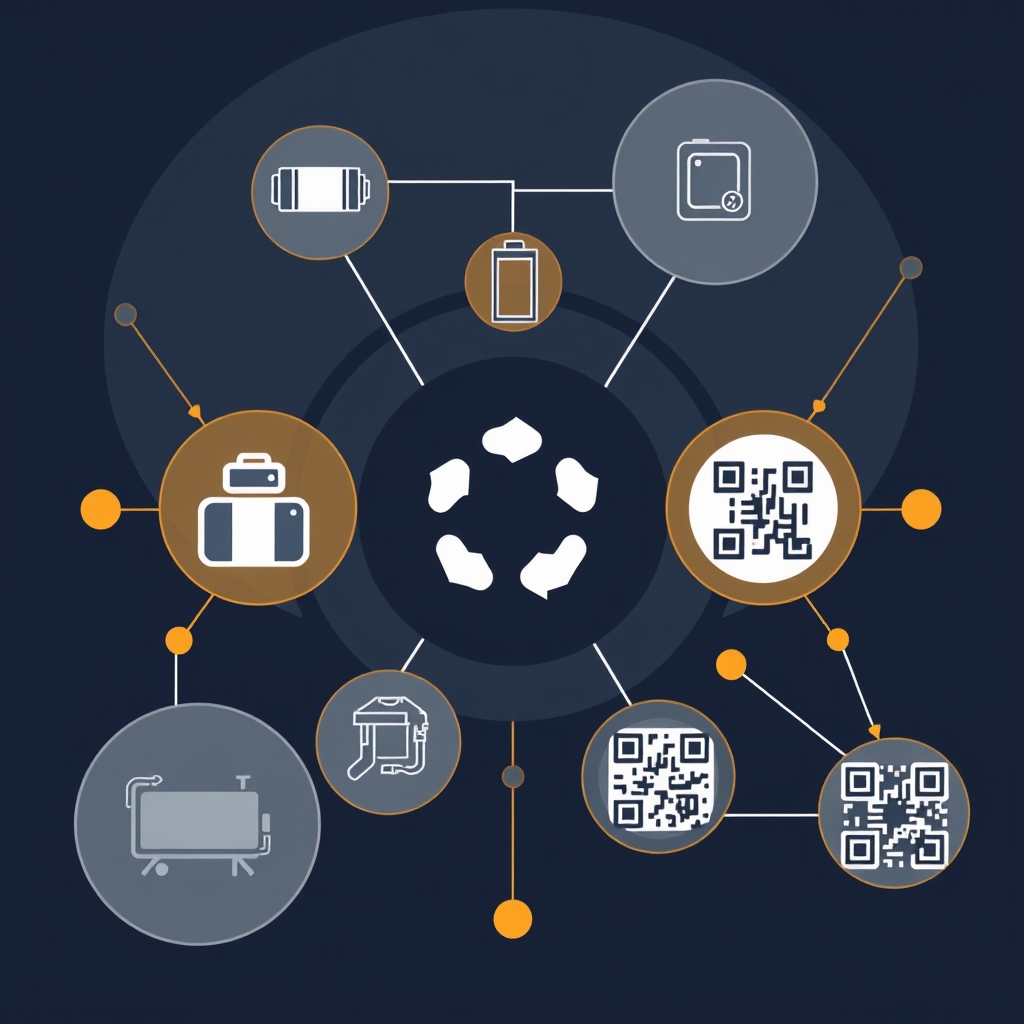
The first product category with hard DPP deadlines is batteries. From 18 February 2027, all batteries sold in the EU must carry visible QR codes under the Battery Regulation (EU) 2023/1542. These codes must be machine-readable and link to data on capacity, chemistry, and hazardous substances.
In parallel, the European Commission has opened a consultation on exemptions from battery removability requirements — affecting wearables and medical devices. However, these exemptions relate to physical removability, not to the DPP obligation itself. The QR code remains mandatory for all categories.
Also noteworthy is the Commission's ongoing "Battery Logic" pilot (launched May 15, 2026): it tests digital passports for LFP-based stationary battery systems of Chinese origin. Verified ISO 14067 carbon footprint data is expected to be integrated by September 2026. This pilot offers insight into how the Commission intends to organize data verification in practice — with third-country producers as a central challenge.
Textiles and the Delegated Act
For textiles, the delegated act under ESPR is expected in 2026/2027. The Fair Trade Advocacy Organisation issued a statement in May 2026 calling for the textile DPP data architecture to remain manageable for SMEs and smallholder farmers in third countries. The Commission faces a genuine tension here: data depth versus accessibility for suppliers outside the EU.
GS1 Digital Link and Sunrise 2027: The Technical Foundation
Why the Barcode Transition Is Not Optional
The GS1 General Assembly 2026, which opened on May 18 in Warsaw, placed the transition to 2D barcodes at the center of its agenda. The reason: from 2027 onward, point-of-sale systems at major retailers in the EU and the US must be 2D-capable. Companies still using linear EAN/UPC barcodes by that point risk scanning failures and compliance gaps.
GS1 Digital Link is the standard that converts a QR code or DataMatrix code into a structured URL. That URL contains the GTIN along with optional attributes such as batch number or expiration date. For the DPP, the key point is this: through structured link types such as gs1:sustainabilityInfo or gs1:epcis, the resolver can route different systems to different datasets — the checkout scanner sees different data than the customs officer or the recycling facility.
A typical GS1 Digital Link for a product with GTIN 04012345678901 looks like this:
https://id.example.com/01/04012345678901/10/ABC123
The resolver at id.example.com evaluates the linkType parameter and redirects accordingly — for example, a request with linkType=gs1:sustainabilityInfo would be routed to the manufacturer's DPP sustainability dataset, while a request with linkType=gs1:pip would be routed to the product information page in the online shop. These are illustrative example URLs used for documentation purposes only.
What This Means for DPP Implementation
The combination of the ESPR Registry and GS1 Digital Link produces the following technical chain:
- The manufacturer registers the GTIN + resolver URL in the central DPP Registry.
- The physical QR code on the product encodes the GS1 Digital Link URL.
- The resolver routes to the appropriate dataset depending on the requesting system.
- The DPP dataset itself resides with the manufacturer or an accredited provider.
This architecture is decentralized — the registry is only the entry point. If you're planning a DPP implementation today, you need to do more than print a QR code: you need to operate a stable resolver infrastructure that remains reachable for 10 years.
Circular Economy Act: The Next Regulatory Wave
The European Commission is simultaneously working on the Circular Economy Act (CEA), with a legislative proposal expected in Q3 2026. According to an HKTDC report from May 2026, the CEA is set to introduce mandatory DPP checks at EU external borders from 2028. This means importers will need to demonstrate that a valid DPP entry exists in the registry before goods can be brought into the EU.
That would represent a paradigm shift: until now, the DPP has been an information tool for end consumers and recyclers. With a customs requirement attached, it would become a condition for market access. For companies with complex supply chains from third countries, this significantly raises the stakes.
At the same time, the consultation on simplified ESRS sustainability reporting (open since May 6, 2026) signals that the Commission wants to reduce the data burden on smaller companies — the draft envisions a 61% reduction in mandatory data points. Whether this simplification will also feed into the DPP delegated acts remains to be seen.
Action Areas for Economic Operators
Three concrete action areas emerge from current developments:
Build resolver infrastructure. The central registry only stores the resolver URL. If you don't want to operate your own infrastructure, you need to evaluate a provider now — one that contractually guarantees the 10-year availability obligation. When using GS1 Digital Link, a standards-compliant link resolver is also required.
Prioritize batteries. The 18 February 2027 deadline for QR codes on batteries is not movable. If you sell battery products in the EU, you need to verify now whether your printing chain (labels, packaging, direct printing) is 2D-capable and whether the linked dataset contains all mandatory fields under the Battery Regulation.
Test Sunrise 2027 readiness. GS1 Digital Link QR codes will replace the linear EAN barcode at the point of sale by 2027. If you're redesigning packaging now, switch directly to 2D — making the change twice will cost more than a proactive transition.
The regulatory pace is high, but the architecture is clear: decentralized data storage, centralized routing, standardized carriers. Understanding this structure early will help you avoid costly corrections down the line.